
dsh-thinking-levels
Per-round thinking-level (reasoning_effort) control for DeepSeek Harness (dsh): pick Auto (a mask) in the session model selector and the plugin schedules low / high / max from the recent tool-call history before submitting the API effort — or fix a wire level (off / on / minimal / low / medium / high / xhigh / max) manually. Cheap tool rounds stay cheap; heavy work never starves.
- English README
- 中文 README
- 日本語 README
- 한국어 README
- Installation guide
- 中文安装指南
- 日本語インストールガイド
- 한국어 설치 안내
- Changelog
- 日本語 changelog
- 한국어 changelog
Compatibility note: Version0.6.0includes Japanese (ja) and Korean (ko) dictionaries and selector entries, but the current official DSH releases expose onlyzhandenthroughLocaleRuntime. On stock DSH, selectingjaorkofails withlocale "<id>" is not registered. These languages will work after official DSH adds the locale IDs. Advanced users can use a DSH fork that updatespackages/client/locale/src/locale-settings.ts(LOCALE_IDS) andpackages/client/locale/src/client/index.ts(LOCALESlabels), together with the corresponding core dictionaries and tests, then rebuild and run the forked DSH. Changing this plugin alone cannot extend DSH's global locale list.
In a multi-step tool chain, the model re-thinks before every tool call — and that thinking dominates the wall-clock time (a 50-step agent task can spend minutes reasoning between tools). dsh-thinking-levels plugs into the agent/request waterfall that dsh re-resolves for every step (registered with prepend so the session model-selection assembly cannot overwrite its decision) and injects a thinking level into the next model request.
Preview
Screenshots of the live UI (dsh web):
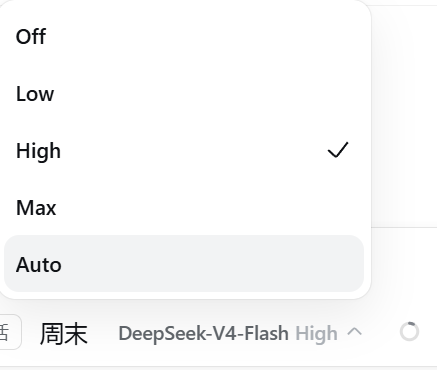
Native model selector gains Auto — pick it and the plugin schedules low/high/max per step instead of a fixed wire level.
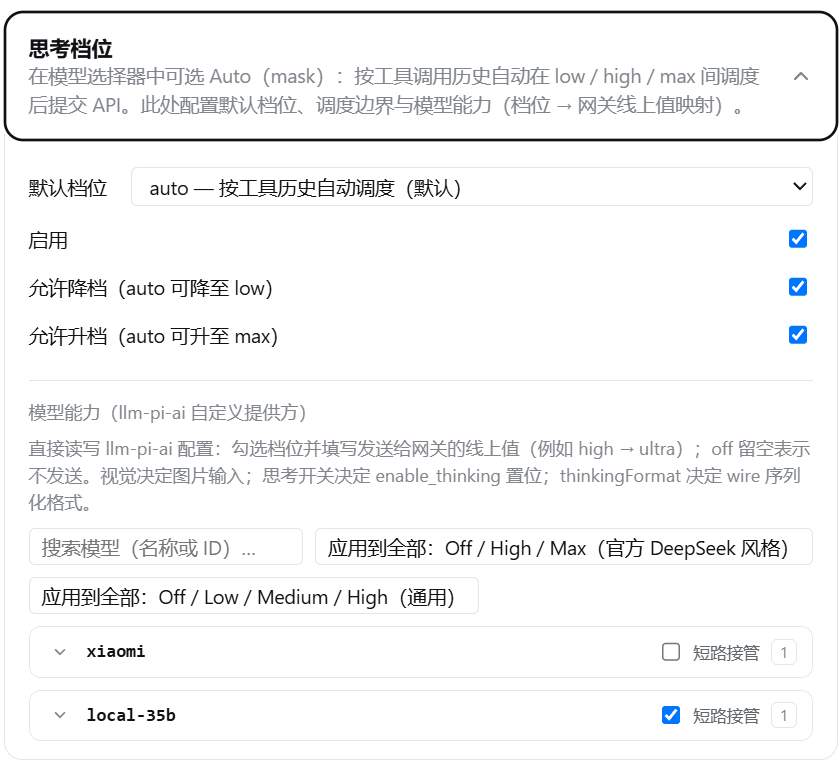
Thinking-level settings card: the auto scheduler plus its boundaries, and llm-pi-ai model-capability mapping (gear → gateway wire values).
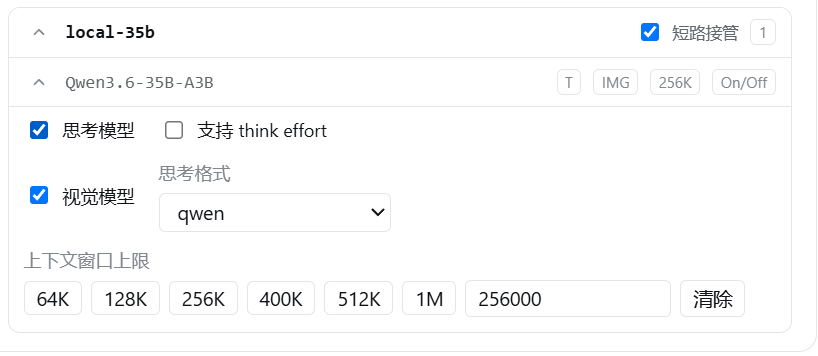
Per-model capability card — pairs with dsh-llm-openai-completions: this card detects & writes capabilities, that adapter takes over the wire (compat.thinkingFormat).
Levels
| Level | Meaning | Where |
|---|---|---|
off | thinking disabled (manual only — never auto-picked) | model selector / default level |
on | thinking enabled (toggle-only models only): sends enable_thinking, never a think effort | model selector / default level |
minimal | least effort (very light tasks) | model selector / default level |
low | manual pick for simple chat tasks (cheap rounds stay cheap) | model selector / default level |
medium | medium effort | model selector / default level |
high | the official default effort | model selector / default level |
xhigh | extra high effort | model selector / default level |
max | heavy work | model selector / default level |
auto | mask: schedule per step from the recent tool-call history, resolved to a wire level before submission | model selector (injected by the plugin) / default level |
Wire-level facts (verified against the official DeepSeek docs and dsh's llm-deepseek adapter): low maps 1:1 on deepseek-v4-flash / v4-pro, while medium / xhigh collapse onto high. The adapter accepts off | low | high | max and rejects anything else with UNSUPPORTED_REASONING_EFFORT — auto is the plugin's mask layer, never sent to the API, always resolved to a concrete wire level before injection. on is not an effort level: it is advertised only by toggle-only models (Qwen3.6-style), and it only flips enable_thinking true — no reasoning_effort is sent; an effort-capable model never advertises on, so a manual on pick on one is stripped.
Custom wire mapping
For hand-declared llm-pi-ai models the settings card lets you map each level to the exact value your gateway expects (borrowed from dsh-thinking-effort): tick a level and enter its wire value, e.g. high → ultra. The mapping is stored as the model's reasoningEfforts table, so the Composer selection High sends ultra to the gateway. Leaving off empty means "do not send".
- Official preset:
Off / High / Max(official DeepSeek style) - Generic preset:
Off / Low / Medium / High
Context-window presets
The settings card's per-model editor now includes a context window limit control: preset buttons 64K / 128K / 256K / 400K / 512K / 1M, a custom integer input, and a clear button. The value is written to the llm-pi-ai model entry contextWindow (integer 2000–1000000).
Upstream, the harness consumes it through resolveModelInfo(...).context.contextWindow for compaction thresholds, context-overflow detection and context-pressure projections. Because llm-pi-ai re-reads the live config on every resolve and the openai-completions takeover does not block model discovery, a settings edit takes effect on the next request without a restart.
The plugin config also accepts models['provider/model'].contextWindow as a validated (integer 2000–1000000) declaration at the composition/config surface.
Model-aware guard (v0.5.0)
The plugin never sends a reasoning_effort to a model that does not advertise one. Custom openai-completions routes (e.g. a local Qwen3.6 without reasoningEfforts) are classified non-reasoning via ctx.llm.resolveModelInfo, and any effort — inherited or scheduled — is stripped instead of sent, so dsh's per-request UNSUPPORTED_REASONING_EFFORT rejection cannot fire. Unsupported fields are never passed to an API that cannot take them.
Version behavior:
| dsh version | low handling |
|---|---|
| rc.6 (old) | not native: the selector only shows it when a configurer-confirmed models override names it; the level is then advertised (selector + request validation) and passed through verbatim |
| rc.7+ (new) | native: the plugin neither rewrites nor re-injects it; a manual low pick passes through unchanged |
The auto scheduler may still pick low for supporting models — the capability guard above is what keeps it away from models that cannot take it.
Model-selector Auto
The session model selector (next to the model) now offers Auto after the wire levels (injected into the model-directory metadata by the plugin):
| Model-selector pick | Behavior |
|---|---|
| Auto | plugin schedules via tool history + the upgrade/downgrade toggles, resolves to low / high / max before submission |
off / on / minimal / low / medium / high / xhigh / max | manual choice wins — plugin does not intervene (on stays on on toggle-only models, never lifted to an effort; effort-capable models strip it) |
| unset | the plugin's default level applies (below) |
Auto scheduler
The hub is high (the official default). auto schedules between low / high / max; it never picks off.
| Recent tool calls | Level |
|---|---|
| none (fresh prompt, pure chat) | low |
| ≥75% simple tools, small args, downgrades allowed | low |
| mixed / heavy tools | high |
| very heavy payloads, upgrades allowed | max |
The scheduling policy is the same source as dsh-tool-turbo (same simple-tool whitelist / payload thresholds / 75% ratio rule).
Install
See INSTALL.md for the full official-CLI guide (profile discovery, upgrade, migration, verification, troubleshooting). Quick start:
# 1. install the plugin into a profile from npm (web shown; any profile works)
#    (the web profile is a pnpm workspace root, so -w is required)
dsh plugin --profile web add dsh-thinking-levels -w
#    GitHub alternative:
#    dsh plugin --profile web add https://github.com/drscrewdriver/dsh-thinking-levels.git -w
#    local-path alternative (no network needed):
#    dsh plugin --profile web add /absolute/path/to/dsh-thinking-levels

# 2. restart dsh web (a running instance does not hot-load new bundle layers)
dsh web
Note: the dsh runtime uses pnpm 11, whose minimumReleaseAge supply-chain policy may block afreshly published version with ERR_PNPM_MINIMUM_RELEASE_AGE_VIOLATION — add the version tominimumReleaseAgeExcludein~/.dsh/profiles/web/pnpm-workspace.yamlto lift the cooling period.
Manual link: registration (alternative to dsh plugin add):
#    ~/.dsh/profiles/web/package.json dependencies:
#      "dsh-thinking-levels": "link:<absolute path to dsh-thinking-levels>"
#    ~/.dsh/profiles/web/cordis.patch.yml:
#      - insert:
#          - id: thinking-levels
#            name: dsh-thinking-levels
cd ~/.dsh/profiles/web && pnpm install && dsh web
Configuration
Two surfaces share one schema:
- Assembly — the plugin row's
config:in the profile composition (e.g.cordis.yml):
  config:
    level: auto            # off | on | minimal | low | medium | high | xhigh | max | auto — the default level when the session picks nothing
    allowDowngrade: true   # let the scheduler drop below `high`
allowUpgrade: false # forbid the scheduler lifting to `max`- Runtime — the dsh-settings namespace
thinking-levels(level,allowDowngrade,allowUpgrade,enabled,models): changes apply to the next model request, no restart needed. A visual editor is available under Settings → Plugins → configurable plugins.
Per-model capability overrides (models, keyed provider/model) confirm what auto-detection finds; the configurer has the final word:
config:
  level: auto
  models:
    llm-pi-ai/Qwen3.6-35B-A3B:   # non-reasoning thinking model (thinking toggle + budget)
      vision: false
      thinking: true
      efforts: false             # never send reasoning_effort (stripped at request time)
    llm-pi-ai/Qwen3.8-27B:       # effort-capable model (rc.6-era adapter without low)
      efforts: [low, high]       # confirm low → advertised in the selector + passed through
For Qwen thinking on/off + budget, configure the llm-pi-ai route instead:
compat.thinkingFormat: qwen(→ wireenable_thinking+thinking_budgetvia
thinkingBudgets), orqwen-chat-template(→chat_template_kwargs.enable_thinking) for
effort models like Qwen3.8-27B.
Defaults: { enabled: true, level: 'auto', allowDowngrade: true, allowUpgrade: false, models: {} }.
Semantics: the model-selector pick outranks the plugin's default level. Pickauto(mask) → plugin schedules; pick a wire level → applied directly; pick nothing → the plugin'sleveldefault is used.allowDowngrade/allowUpgradeconstrainautoscheduling only.
Auto-takeover of dsh-llm-openai-completions (v0.5.2)
Custom gateways (vLLM / LM Studio / self-hosted OpenAI-compatible proxies) must be served by dsh-llm-openai-completions once they declare thinking (reasoningEfforts table in llm-pi-ai) — otherwise pi-ai sends role: "developer" (400) or drops enable_thinking. This plugin maintains the takeover list automatically:
- Scans
llm-pi-ai.providersfor providers that are custom openai-completions gateways
(api: openai-completions or a non-official baseURL) and declare a reasoningEfforts table on any model;
- Merges them into
llm-openai-completions.providerswithenabled: true(existing manual
entries are preserved, deduplicated);
- Triggers on plugin start,
llm/adapters-updated, and settings changes tollm-pi-aior the
takeover list — no manual config editing;
- Soft-coupled: skips the write silently when
llm-openai-completionsis not installed (its
namespace is unregistered).
The takeover mechanism as a whole — control-plane contract (who is taken over, how a control-layer plugin decides and injects) and transport-plane wire contract — is standardized in the Takeover Control Spec; this plugin is the reference control-layer implementation of it.
Dependency note
The host half does not value-depend on @deepseek-ai/dsh-settings (settings registration goes through the cordis settings service provided by the dsh runtime) — no need to install official packages into the profile manually. dependencies is just @deepseek-ai/schemastery (installed automatically with the package).
Development
npm run lint        # eslint (typescript-eslint flat config)
npm run typecheck   # tsc --noEmit
npm test            # vitest — 46 tests
Test coverage: level policy (manual pass-through incl. the extended levels, on clamping, auto scheduler, validation, simple-tool boundary), the model-capability guard (reasoningEffortSupported, resolveEffortInjection stripping/passthrough), session-event parsing (guards, window cap, malformed records), the config schema (defaults lockstep, out-of-band rejection, models overrides), and takeover-sync (identification, dedupe merge, soft-coupling).
License
MIT
