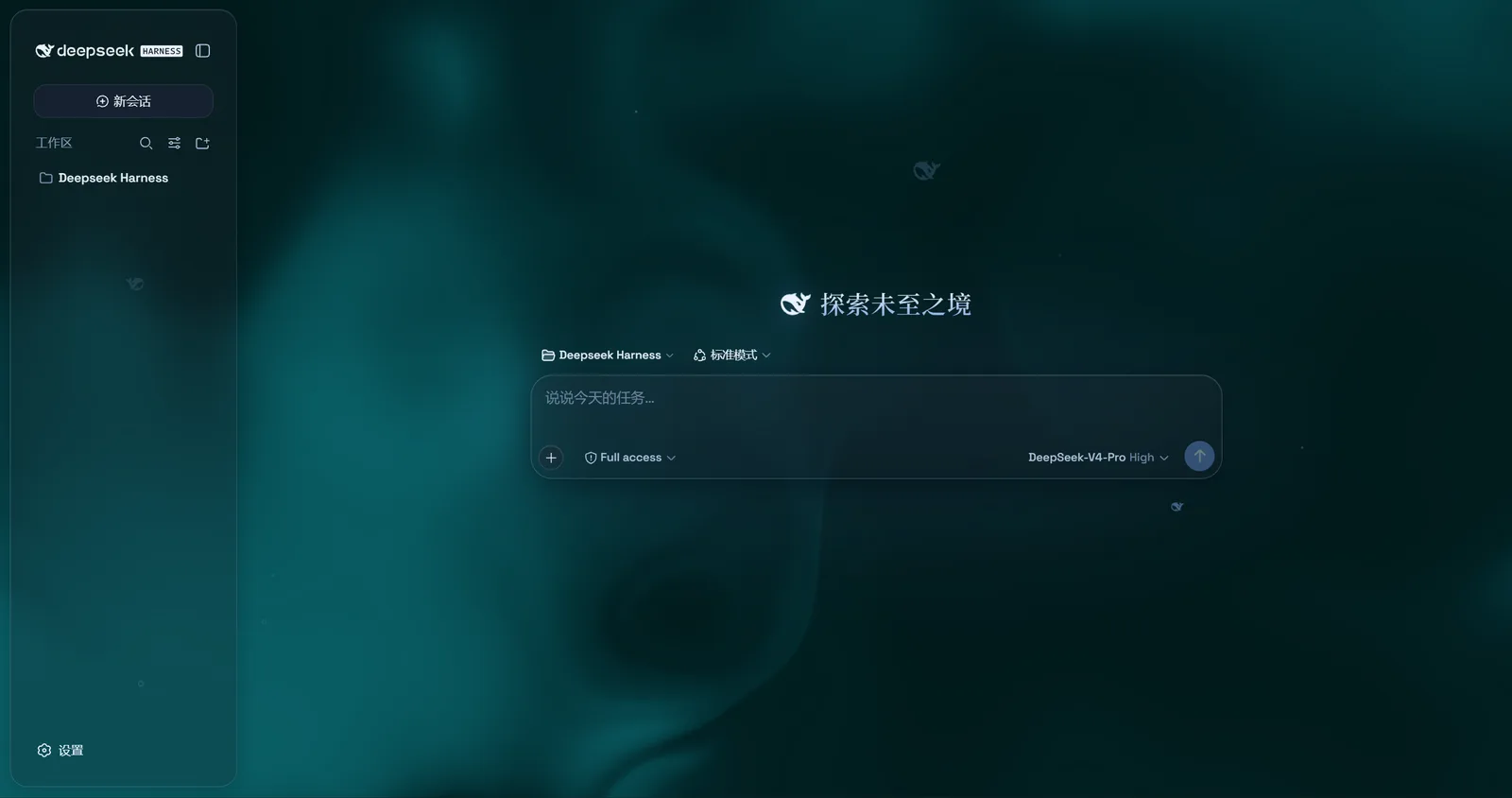
dsh-skin
Skin switcher + custom wallpaper + 奶龙桌宠(desktop pet with sticker pack) for DeepSeek Harness — a "change the skin" feature in the spirit of Codex themes. It registers a curated catalog of palettes into DSH's built-in theme runtime and adds three rows to Settings → General (below the built-in Appearance row):
- 皮肤 / Skins — pick one of 7 curated palettes (or 默认 / Default to
follow the built-in appearance).
- 背景图片 / Wallpaper — local image, or paste an image/video URL; opacity,
blur, and fit (cover / contain / stretch / tile).
- 奶龙桌宠 / Pet — a floating, draggable yellow-dragon desktop pet with an
8-mood sticker pack (表情包). It follows the agent's running state (idle → thinking → working → done → sleeping), blinks while idle, falls asleep when idle too long, can be dragged anywhere (position remembered), and shows a 🎨 sticker panel where you can pick any mood manually. Toggle it, resize it, or reset its position from the settings row.
Both choices persist across reloads (localStorage). A saved third-party skin is re-applied once on boot (DSH only persists system/light/dark itself).
How it works
DSH's theme system is token-based: the web shell ships --dsw-* design tokens, and ThemeRuntime lets third-party plugins register themes that override the alias layer (--dsw-alias-*) per color scheme. This package is a regular dual-face plugin:
- Host half (
lib/index.js) — adsh.bundlepatch layer that inserts one
loader entry (skin); a no-op apply, exactly like the shipped ui-* packages.
- Browser half (
lib/client.js) — adsh.clientbundle (served at
/plugins/dsh-skin/client.js) that:
- registers 7 curated skins via
ctx.theme.register(...); - restores the saved skin id and applies it with
ctx.theme.setTheme(...); - renders the wallpaper as a fixed backdrop layer (
z-index: -1) and stacks
a token override (ctx.theme.overrideTokens) that makes the main canvas (--dsw-alias-bg-base) and sidebar (--dsw-specific-sidebar-fill) translucent, so the image shows through while inner surfaces (cards, inputs, bubbles) stay opaque and readable;
- keeps the slot stores in sync with
theme/change(and re-shades the
wallpaper when the active skin or light/dark scheme changes);
- mounts both rows into
settings.general.item; - mounts the desktop pet (a fixed, draggable element with inline-SVG
stickers) and watches the agent's running state through ctx.get("sessions").list() to switch moods.
Each skin sets its colorScheme (light/dark), which drives body[data-ds-dark-theme], plus alias-token overrides applied as inline custom properties on <body> by ui-layout's ThemePresenter.
Skins
| id | scheme | vibe |
|---|---|---|
skin-ocean | dark | DeepSeek-blue deep sea |
skin-graphite | dark | neutral monochrome |
skin-forest | dark | green calm |
skin-sunset | dark | warm purple |
skin-midnight | dark | pure black OLED |
skin-paper | light | warm paper |
skin-sakura | light | pink accents |
Ids are namespaced (skin-*) so they do not collide with official @deepseek-ai/dsh-client-ui-console themes (sakura, graphite). Saved unprefixed ids are migrated on read.
Picking 默认 / Default reverts to the built-in appearance (follow system) and clears the stored skin.
Wallpaper
In Settings → General → 背景图片 / Wallpaper:- 选择图片 / Choose image — pick a local image (≤ 2MB, stored as a data URL, kept in this browser only). Local video files are not uploaded; paste a URL instead.
- 网址 / URL — paste http(s) / data image or video (mp4/webm/ogv/mov). blob is rejected (dies on reload). No extra media server.
- 显示方式 / Fit — cover / contain / stretch / tile.
- 界面遮罩 / UI wash and 模糊 / Blur sliders (rAF-coalesced; no crash). Higher wash = more solid UI.
- 移除 / Remove clears it.
The wallpaper lives on a z-index: -1 fixed layer, so it is only visible through the translucent main canvas and sidebar; message surfaces keep their solid backgrounds for readability. It also follows your active skin's tint (switching skins re-shades the translucent surfaces).
奶龙桌宠 / Pet
In Settings → General → 奶龙桌宠 / Pet you can show/hide the pet, resize it (64–180 px) and reset its position. Behavior:
- Status moods — the dragon follows the agent:
thinkingwhen a turn
starts, working while it runs, done (with sparkles) when it finishes, then back to idle. Left idle too long it falls asleep (sleeping, Zzz).
- Sticker pack (表情包) — hover the pet and open 🎨: 8 moods to pick
(idle / happy / thinking / working / done / sad / surprised / sleeping). Clicking the pet also cycles to a random sticker for a few seconds.
- Draggable — drag it anywhere; the position is remembered
(dsh-skin:pet-pos). Reset it from the settings row.
- Zero assets — every sticker is inline SVG (original hand-drawn art in a
Nai-Long style, not the licensed character), so the bundle stays dependency- free and crisp at any size. preview.html in the repo shows the full pack.
Persistence
Choices are stored in localStorage (dsh-skin:skin, dsh-skin:wallpaper, dsh-skin:wallpaper-opacity, dsh-skin:wallpaper-blur, dsh-skin:wallpaper-fit, dsh-skin:pet-enabled, dsh-skin:pet-size, dsh-skin:pet-pos). DSH's Host settings wire only exposes an allowlisted set of namespaces to browser clients (WEB_SETTINGS_NAMESPACES in dsh-host-apiproxy), so a third-party namespace would answer settings-not-exposed; the product itself keeps remote browser preferences process-local, and localStorage matches that boundary for a visual preference while surviving reloads on the same origin.
Install
From anywhere, add the package to the web profile:
dsh plugin --profile web add -w /path/to/dsh-skinThe-wflag is required: every profile ships apnpm-workspace.yaml, so
pnpm 9 treats the profile directory as a workspace root and refuses a bare
addwithERR_PNPM_ADDING_TO_ROOT.
This runs pnpm in ~/.dsh/profiles/web, installs the package, and appends it to dsh.profile.bundles (its patch layer inserts the skin loader entry). The running web server must be restarted to pick up the new bundle layer:
# stop the running instance, then:
dsh web
Open Settings → General to use the skins, wallpaper and pet.
Publishing (npm)
DSH (rc.6) has no separate plugin marketplace — the plugin distribution channel *is* the npm registry. A package that declares dsh.bundle (host patch layer) and dsh.client (browser bundle) is exactly what dsh plugin --profile <name> add <package> installs, so publishing this package to npm is what "上架" means today:
- Pick a unique name (scoped names are safer, e.g.
@yourscope/dsh-skin) and
fill in author, repository, keywords, and a CHANGELOG.
- Make sure
filesshipslib/index.js,lib/client.js,lib/types,
cordis.patch.yml (already configured).
- Publish to the official npm registry (this machine's default registry is
a mirror — publishing to a mirror does not reach npmjs):
npm publish --registry https://registry.npmjs.org- Users install with:
dsh plugin --profile web add -w @yourscope/dsh-skin then restart dsh web.
Known platform boundaries to document for users: browser-side preferences are stored in localStorage (third-party settings namespaces are not exposed over the wire yet), and the client bundle may only require module-table entities (platform seeds + registered client bundles).
Development
The client bundle is written directly in the __ModuleLoader__ bundle format (the same shape tsdown emits for the shipped ui-* packages), so no build step is required. lib/client.js may require only module-table entities: platform seed words (react, react/jsx-runtime, …) and registered client bundles (@deepseek-ai/dsh-client-runtime/client, @deepseek-ai/dsh-client-ui-theme/client, …). After editing, restart the web server (bundle content is re-hashed and served with a new rev; loader entries are rescanned at boot).